Petionville, Haiti

Petionville, Haiti

Sunday, February 28, 2010

DR - II

He was the last patient of the day, with the (simple enough) complaints of nasal stuffiness and discharge, facial pressure and cough. I had gotten used to the organized chaos of the clinic – the myriad patients pointing to their throats, measuring out GERD or allergic rhinitis medications into small envelopes, writing makeshift prescriptions on post-it notes in limited Spanish – and was expecting a nice textbook case of chronic sinusitis with which to round out the day.

I was halfway into that particular question algorithm when the patient’s daughter quietly interrupted. She handed me a piece of paper with a biopsy report dated seven days prior stating that her father had a sinonasal undifferentiated carcinoma, a malignancy with an extremely poor prognosis even with optimal surgical and adjuvant treatment. I looked at the report and then glanced at the patient, who continued to talk happily without a care in the world. I asked him (through the translator) what he knew about his condition, and he stated that he knew he had a biopsy, but nothing more.

This was a relatively alien situation to me, as aside from PCM sessions with standardized patients, I’ve never had to tell anyone that they had a malignancy with an extremely poor prognosis. I decided to let the attending deliver the news and conducted a thorough physical. Once I left the room, I took the translator and the patient’s daughter with me to present the patient. We explained the seriousness of her father's condition and the necessary therapeutic options. The patient’s daughter was insistent that her father not be told about his diagnosis. As visitors to the country, we agreed, but wrote her a letter of referral to the country’s only cancer center should she change her mind. After several awkward moments dictating said letter to an exceedingly patient Peace Corps volunteer, she thanked us before we went to examine her father further.

My time at Loyola taught me, among other things, the importance of patient autonomy and its place as a cornerstone of American medical ethics. We did not impose this particular value in this case, and did not feel as if we'd committed a grave ethical misstep. Indeed, the same scenario might have played out exactly as described in my family. It would take more than a blog entry to fully discuss the differential value of patient autonomy in Santiago versus Chicago. Cultural sensitivity notwithstanding, I still felt a pang of guilt when, upon leaving, the patient asked if his nasal stuffiness and facial pressure would ever improve. I told him that the medications we provided would take care of his symptoms, all the while glancing at his daughter to see if she'd change her mind. She didn't. They left and I wished them well.

Ryan JE Salvador, MSIV
Santiago, DR

DR - I

Clinic at the ILAC medical campus reminded me of Hines General Surgery clinic, except with a more tropical flavor. This consisted mainly of a) the presence of a Spanish translator, b) mosquitoes and c) the fact that I had a rather nice view of a palm tree from my window. Otherwise, the long lines of patients waiting outside and the implicit pressure to see as many as possible as quickly as possible were both familiar and exhilarating. What surprised me most was that none of the patients that I saw ever stopped an interview and asked for "the real doctor" to come in. Indeed, they were as grateful for the opportunity to be seen as I was for the opportunity to see them. Despite the immediate availability and supervision of several attendings, the amount of autonomy provided to us medical students was unprecedented. It truly was an excellent learning experience.

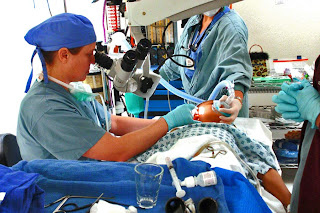
This enthusiasm for medical care extended to the surgeries; a patient walking from the preoperative area to the operating rooms was always accompanied by a quick prayer, a pep talk and applause. It was in rather sharp contrast to the somber atmosphere that accompanies the American patients’ journey to the ORs at home.

On a side note, I rue the day I took French as opposed to Spanish in high school. Even though it helps slightly with understanding certain culinary terms, no one at LUMC has ever asked for a French translator.

I was on call with another non-Spanish fluent student on a night when the patient dorms were full of patients who had thyroidectomies. Prior to our shift, we'd attempted to learn choice Spanish sentences and phrases ("Are you in pain? Do you have tingling around your mouth and fingertips? Are you nauseous? May we see your wound?"). We asked these questions upon checking our patients every two hours, all the while hoping that the answer would be "No," as anything other than that would necessitate further questions in broken Spanglish and probably a change in management. Through sheer luck, the answer was always "No." It was a good night.

Ryan JE Salvador, MSIV
Santiago, DR

Friday, February 26, 2010

Paucity of Language?

The ability to express oneself is a curious thing. More than just the sum of the words that compose the sentence, salutation, soliloquy is a complicated interaction of inflections, cadences, and timings not to mention the facies, stances, and gesticulations that may accompany whatever is being said. For example a farmer casually drying his hands from washing apples drawling “How do you like them apples?” is far different from a boxer menacingly shaking his fist at his opponent asking the same question. The context and theater of speech is as important to communication as the words of the message. Indeed one could even consider everything surrounding the actual words parts of speech unto themselves and absence of any parts substantially changes the message. This is no more apparent than when travelling in a foreign land without adequate (or any) knowledge of the local language.

Such was the case while we were in the DR, but fortunately for us we had the assistance of several Peace Corps volunteers (PCVs) to aid in translation. For clinic, interviews rode the slow train from English to Spanish and back, which made things difficult when seeing upwards of 80 patients daily. In an effort to improve efficiency, I tried to learn the basic introduction of name and role and thus spare the interpreter from doing everything. To my credit I have several years of French under my belt, plus a decent understanding of Latin root pronunciation, and so I thought I could muscle my way through the introduction. Every patient, without exception, smiled politely at my attempt and then turned to the interpreter to find out what I had just said. On woman presenting with an apparently painful thyroid nodule just started laughing and shaking her head, before seeking the translator's help. In between patients one of the PCVs told me not to take it personally, the people were just not expecting me to speak Spanish, so they would tune it out regardless even if I had spoken flawless Dominican Spanish. So with that in the back of my mind, I foraged ahead focusing on the language that I knew better than Spanish: eye contact, “interested” eyebrows, positive vocal inflection and a forward lean. For the most part it worked well though I did run into a little trouble on the last day of clinic.

In the mild chaos that was the last day we were attempting to both close shop and pack-up supplies while finishing up clinic and operations. In addition to sorting and packing I was also pinch-hitting as the only student taking care of the last few patients coming through clinic. I was a little short on sleep at the time and was keeping my spirits buoyed by humming to myself. In the midst of things I was asked to flush wax out an elderly woman's ears so that she could get a hearing test. With the same PCV who had been helping my Spanish skills, I went to work irrigating entrenched wax plugs out of her ears. In similar situations in the US, I make light of my difficulties by giving the patient status updates in a rather sing-song fashion thereby breaking some of the tension in the room. However, as I was doing this I realized that this poor woman had no idea what I was saying and could only imagine what she was thinking about this odd young man alternating serenading and blasting warm water into her ear. I asked the PCV, Sarah, to feel free to translate in whatever fashion she felt was best. Thankfully she chose calm matter-of-fact prose to more lyrical reassurances. I guess if I do something like this again in the future I will try harder to learn the primary language as opposed to just letting my body language do the talking.


Christopher Janowak MSIV
Santiago, DR

Thursday, February 25, 2010

No Habla Espanol

For those of us who are linguistically challenged, medical trips to Latin America often have an added layer of confusion. During our trip to the the Dominican Republic an obvious barrier to overcome was the language gap. Despite the fact that our peace corps translators were fantastic, there is no substitute for understanding words straight from the patients mouth. Out of the 8 medical students on the trip 2 were functionally fluent, 2 were able to get by, and the other 4 of us really lacked any Spanish language skills at all. This made for times in clinic that could be as frustrating as they were entertaining. For example, take my often asked question, "How many times have you had a sore throat in the last year?" Right around 100% of the time this question would send the patient into a monologue of at least several minutes in duration, none of which I would understand. At the end of the rant my translator would mutter something else in Spanish, and then turn to me and say, "Once." The first couple times this happened I asked what else the patient had said. The translator would then proceed to tell me how the patient talked about the "gripe" they had six months ago, the concerns they had with the local hospitals, how they didn't like the doctors in the DR, none of which had anything to do with my original question. And, while I was well versed in dealing with tangential answers and redirecting patients in the U.S., my lack of Spanish comprehension made it impossible to do so in the DR. By the end of the first couple patients, I found that I had to trust my translator to filter out the things that were insignificant to the chief complaint. Having them translate every single word would cause us to spend over an hour with each patient. This was something that we could not afford when each student needed to see 15-20 patients in clinic each day to get through everyone.

The peace corps translators were very capable, intelligent people. As one can read in previous posts, they all had amazing projects that were doing much more for these communities than our 1 week surgical trip. They had a solid command of the language and were absolutely vital throughout the entire trip. Yet, one problem I found as our the days wore-on was that the translators were being forced to play doctor. The peace corps translators were doing what we had been learning these last four years, except without any medical training. They were listening to the patient's story, ignoring those parts deemed to be insignificant and then picking out the salient details to communicate to us. And, while I did have faith in the peace corps volunteers' abilities to pick up on the basics of obstructive sleep apnea or recurrent tonsilitis, I did not expect them to be functioning on the level of nurses or physicians. Yet, this is the position many were forced into during the long days in clinic. It is important to note that rarely, if ever, during our trip was this sort of analytical translation ever detrimental to patient care. Still, I believe it was definitely less than ideal to have the translators doing as much doctoring as the medical students. Unfortunately, the time constraints and absent Spanish skills of students like me necessitated this approach. The question then is how would we be able to avoid this in the future? The simple solution is we would need more medical students who were fluent in Spanish. Only then would the patients get straight from the doctor medical advice.

The sad fact is that there are many medical students like me who lack basic foreign language skills. I would venture to guess that far less than a majority of medical students in the United States have conversational fluency in a non-English language. It is something that I regret every day when on-service at Loyola, not being able to converse with the multitude of Spanish speaking patients. I can get by with my "Te duele?" or "Respire profundo," but I really lack the ability to conduct a meaningful history and physical. At Stritch, we have Medical Spanish as an elective you can take, or as a course you can take outside of school. I believe having Medical Spanish as a required part of our curriculum would be beneficial. Given our schools commitment to international medical outreach and ISI trips, it makes sense to teach the language skills that so many of our students will need in the near future. More importantly, Medical Spanish is a skill that is often required in our community here in Chicago and all across the U.S. Indeed, its inclusion in our curriculum would serve to improve the capabilities of the class as a whole in future clinical practice at home and abroad.

Brian D'Anza, MS4
Santiago, DR

ENT in DR -- Sustainability

Whenever I come back from a mission trip to a 3rd world country, not that I've gone on a lot, I always wonder about the lasting impact that we made. The reality is, probably not much. I remember when I went to the DR for my ISI trip, we doled out GERD mediation, antibiotics, vitamins, etc. to almost every patient we saw. The got treated for their illness, but the sad part was that they would get sick again. They will get parasitic infections again, UTIs, the consequences of acid reflux, etc. again once the medication runs out. It seemed to me that we were fighting a losing battle.

Surgical trips seemed to make more sense to me. They could fix hernias, remove tumors, repair joints, create fistulas for dialysis, etc. and that wouldn't depend on a long lasting supply of medication. The patient would come in for a one day surgery and possibly be rid of their ailment for the rest of their lives. I think that is one reason that drew me to ENT in the first place. The ability to practice medicine, but also surgery.

In the DR, we saw a lot of patients with GERD. We gave them whatever medications we had and they'll feel better as long as they have the medication, but once they run out, the problems will return, unfortunately. We saw a lot of patients with obstructive sleep apnea secondary to large tonsils and adenoids. We were able to remove those obstructing appendages and the child is "cured" of their apnea. I find that amazing because a 15 minute surgery was able to do that. We also performed about 8 PV cases to create AV fistulas for dialysis for patients with renal failure. Now these patients will be able to get dialysis and improve their quality of life.

However, medicine to me has always been an acute fix. It exists to fix problems when they occur. For these 3rd world places that I visit, their problems are more systemic. Their health problems exist because of their lack of infrastructure and no amount of medicine/surgery can fix that. The amazing part of this trip was in meeting the Peace Corp volunteers and hearing about what they are doing for the communities -- things that are sustainable.

One person is helping her village develop a clean water supply system. Clean, running water will go a long ways in terms of public health and cutting down on infectious diseases. Another person is helping to develop a computer curriculum for his area. That will help bring the people there up to speed with the rest of the world in terms of technical know-how and put them in position to compete for better jobs in the future. Technology is so interwoven into our daily lives these days that knowing how to use computers is a necessity.

The projects that the Peace Corp volunteers are undertaking are the type of projects that can make lasting changes. Something that our 1 week long medical mission trips can't do.


David Chan, MS4

Wednesday, February 24, 2010

ENT in the DR

Assumptions can be misleading. I found this to be the case upon first arriving at the ILAC center as part of the ENT medical mission trip to the DR. I had envisioned sleeping in small huts, possibly with dirt floors, an open air clinic, surgery suites that were little more than a wall and some ancient surgical instruments. I figured the ILAC center would be similar to the other "hospitals" I had encountered in my prior medical relief trips to developing countries. Some 6 years ago I went on my very first international medical relief trip. We went to the DR to help the sick. Our time consisted of setting up clinics in small tin roofed buildings, thatched huts, and abandoned school buildings. It was an eye-opening experience and one that led me to join several relief trips during medical school. So, when signing-on to join the ENT department's trip to the DR, I had figured that the settings of the ILAC center would run in line with my expectations drawn from these past experiences.

When we arrived, I found the living situation to be entirely different from what I expected. Simply put, the ILAC center was a beautiful gated compound. It had two story buildings, a flowered courtyard, a cafeteria, and lush gardens. They had wireless internet access, four available computer stations, warm showers, and even air conditioned rooms for the attending physicians to stay in. In a sentence, I thought I had landed in a resort. After absorbing the initial shock of being able to flush my toilet paper, I began to wonder if this was more a vacation than a medical service trip. My first thought was "what kind of people are we going to be treating here?" Surely if such a wonderful compound can be maintained, there are more than enough health care professionals willing to join and see patients. Were we really going to be seeing people who lacked access to care? Were we going to be treating people who had problems with their health, or was this just a medical tourism trip?

My pessimism regarding the efficacy of our trip bothered me most of the night before our first clinic day. It continued into the next morning as were were escorted to the clinic and OR site. The clinic was actually a real clinic, complete with individual consultation rooms, examination table, along with otoscopes we had brought from the states. The patients we consulted with, however, were definitely different. As one can read from Matt's posts below, we encountered all sorts of interesting and extreme pathology. From the thyroglossal duct cyst to massive thyroid goiters and everything in between, our patients were far from well-to-do. And, so I am happy to say that my initial impression was wrong.

So what does it matter? Well, the learning point in this whole thing is easily found. My primary fault was in linking the facilities of our stay with the health care of the community. My past experiences with global health trips had etched in my mind the idea of only offering true help to patients in areas where no health infrastructure existed. The first day of our trip showed me that infrastructure and drugs do not guarantee excellent health care. Indeed, I had not realized that the necessities we shared were our skilled hands, minds, and teamwork.

The people needed to properly outfit, run, and process a surgical trip are vastly different from the medical trips I had been on in the past. Some 40+ people comprised of pre/post op nurses, scrub nurses, CRNAs, surgeons, anesthesiologists, residents, translators, surgical tech staff, and medical students were all absolutely vital to the trip running smoothly. The first couple days of the trip really taught me how different a surgical trip can be in its needs and requirements. In the end, our first day in the OR showed me how absolutely necessary our team was. This was nowhere close to a medical tourism trip, nor was it a vacation. The skill provided by the doctors, nurses, and ancillary staff was needed to take care of patients in a surgical setting that is not found in the DR. We were treating patients who should have had their thyroid, tonsils, or congenital pathology removed years ago. People who would have to wait a year until we returned to get their procedure done. And so, the learning experience I found was in not making assumptions. My assumption was that the value of a medical trip was inversely related to the conditions in which we imparted our care. I have learned that this is not a good barometer. Instead, if we measure our worth in the skill and experience imparted to our patients, we will find a much more accurate view of the impact of our medical trip.

Brian D'Anza MS4
Santiago, DR

Monday, February 22, 2010

Thoughts on PeaceCorps


So I just returned from the Dominican Republic after eight days with Loyola ENT at the ILAC mission outside of Santiago. 485 patient screenings and 119 surgeries later, I am back in the United States and I've got a few things on my mind. At present, I should be reviewing material for the last half of the Step 2 medical licensing examination, but I think time would be better spent musing about a few things.


While in the DR our group needed translator assistance to help out the linguistically challenged medical staff. Towards that end we picked up seven very capable Peace Corps volunteers who took time out of their respective projects to facilitate the daily workings of our clinic. Over the course of the week we got to know the Peace Corps volunteers quite well and heard each's own story of how they came to where they are right now: in a foreign land working with people they arguably don't know on tasks for which many of them had no prior experience let along expertise. My respect for them is genuine and without equivocation.


Indeed I have met quite a few Peace Corps alumnae in my class who are very hard working, globally minded individuals, with solid senses of personal and professional direction. Sure there are a few who suspiciously seem to have learned nothing from there experience, but that could be said about people in any situation, let alone one requiring as much fortitude as Peace Corps.


Peace Corps was a pubic service initiative that was founded by an executive order from the Kennedy Administration to spread aid and foster US-foreign relations in underserved communities. Unlike its uglier domestic step-sisters (eg. Teach for America, or AmeriCorps) the Peace Corps requires a much longer time commitment. This makes it an excellent tool for undertaking long term projects if it takes advantage of developing generative projects that can, in the best case, adopted and run by communities being served or at the least handed off to the next volunteer in the area. Such projects can be as simple as a teaching computer technology skills in developing nations or as complex as managing sustainable crop growing strategies in marginally arable areas. One of the translators, an ex-swimwear model, told me a her project to develop reliable and efficient sanitation to her community. How she had worked with the community leaders to outline a way to protect the drinkable water supply by first creating a way to collect and quarantine waste, how she was furiously writing grants to obtain funding to start working through the phases of her plan, and how she planned to get the project started for the next volunteer to complete. From my own perspective, having as much difficulty actually generating waste as I have, I was just impressed at the mind-boggling layered planning. Many very capable people in the United States cannot put together projects with any foreseeable planning for subsequent phases, even with the vast resources that a well developed western society has to offer. Thus a well described (or at least well intended) plan of action from someone in the field whose prior training in waste disposal included little more than using acetone to strip fingernail polish is absolutely stunning.


The unfortunate reality of the situation is that Peace Corps has an institutionalized handicap built into its framework: no volunteer is allowed to remain in on location for more than five years. The rationale for this rule is to keep the ideas generated and implemented by the sharp end of Peace Corps (the volunteers) fresh and new. After all, one of the missions of Peace Corps is to foster American understanding of cultures abroad so that their influence on the volunteers can be translated back to America upon their return home (though returning home can be particularly difficult for the volunteers). Returning to the longevity of development projects, this renewal of personnel costs projects time and may cause them to stall out entirely if the volunteer is either not suited to the project or if the community does not grow out of the hand holding that Peace Corps is willing to offer. One of the things I respected the most about working with Habitat for Humanity was their presence of mind to be upfront about giving “a hand up” not “a hand-out”. Future owners were expected to be partners in process not just worthy/gracious recipients. This could be enforced by the long term governance of Habitat Boards, but I wonder how this could be handled in the Peace Corps without stirring up the old fires of suspicion that plagued the early volunteering efforts. In the 60s PCVs were criticized for being neo-imperialists inflicting Americanism on the locals like as though they soiled the very ground they touched. Another one of our PCVs told us that the people of her community were afraid she was a CIA spy for the majority of the first year she was in country. “What was I going to spy on,” one of her friends argued on her behalf, “ the bananas?” Regardless, America has had a number of questionable moments in its history, such that even positive programs like the Peace Corps must tread lightly, even if it means sacrificing progress for diplomacy.


Beyond the programs of the American mission abroad, what can be said about the volunteers themselves? At first glance you could make them out to be quite heroic folk: separated from thoroughly American upbringings, often following college ridiculousness, and placed into often poverty stricken areas. They're given a pittance of a salary, a nebulous job, and asked to MacGyver something out of it... if only they had the requisite swiss army knife, rubber band, and chewing gum. But what causes these graduate of higher education to sojourn into the unknown? As so many land-grant college graduates know, liberal arts educations do not gain you jobs. Education in America has turned towards acquiring technical skills to take you into the next salary bracket, which has unfortunately left the educational philosophy of “learning how to learn” to a minority of students. No longer are classical educations taught so that the strengths and weakness of the past can be examined to help shape future decisions, rather we are taught how to tabulate and compound, strategize how to operate within the rule that other men have set up, rather than examining and enhancing those rules. No. Like lemmings marching towards an unknown inevitability we scamper to get out degrees, our jobs, mates, mortgages, and some kids so that we can sit down with a six pack and watch our sitcoms or NASCAR. Is it in this light that some choose to spread their wings and take a chance with the winds of change that Peace Corps may bring? I would guess that it is something slightly less romantic where the volunteer is not sure what he or she wants to do with life yet and does not want to just plop down in the first employment opportunity that winks at them and buys them a drink a the bar. So they take a chance, hoping that biding their time doing something ostensibly positive in the ether of existence may eventually light the spark. Two years of reflection. Two years of the most contemporary liberal education available. Two years to find out how they can make their impact on society, or at the very least constructively contribute to the America that they had the unique experience of seeing from outside in. And now with Bush II, and Obama expanding the number of volunteers in a time of economic floundering there will be more opportunities for our generation to find their way to the benefit of many.

Of course, this may just be a guess and wishful thinking, but I don't know how anyone could come back from that experience and not be changed in such a way that they could be satisfied going back to the states and languish away pushing pencils to keep the American machine humming. However the return home can be equally as big of a leap as leaving the secure confines of your culture. Riding in the state rooms and on the deck of the cruise ship does not let you see all the dents, dings, barnacles and corrosion that is readily apparent from the decks of smaller vessels passing by. Life is simpler when you have less making things like right and wrong much easier to discriminate especially in a wider view like an ethos or core belief. Moving back to the land of plenty with its infinite spectrum of grays between black and white could easily be daunting enough to inspire one to look for a way out back to simpler... which may not be that bad of a thing, at the very least its a plan.


At the end of the day, the Peace Corps is an institution that is hard at work for all Americans, shaping the image of the US abroad while also structuring and strengthening its volunteers to transcend the rote for something greater. I would like to think that, given the option, I would be able to do something like this but I realize that my palsied french abilities, extreme xenophobia, combined with my generally goofy appearance means that I would probably be less than successful. However, this does not exclude me from being a swimwear model.


Thank you again to all who have supported this trip, to the ILAC mission in Santiago, and a special thanks for the tireless efforts of our Peace Corps volunteers. I wish you the best in the future.


Christopher Janowak MSIV

Santiago, Dominican Republic